More Takeoffs Than Landings
Part One: The T-33
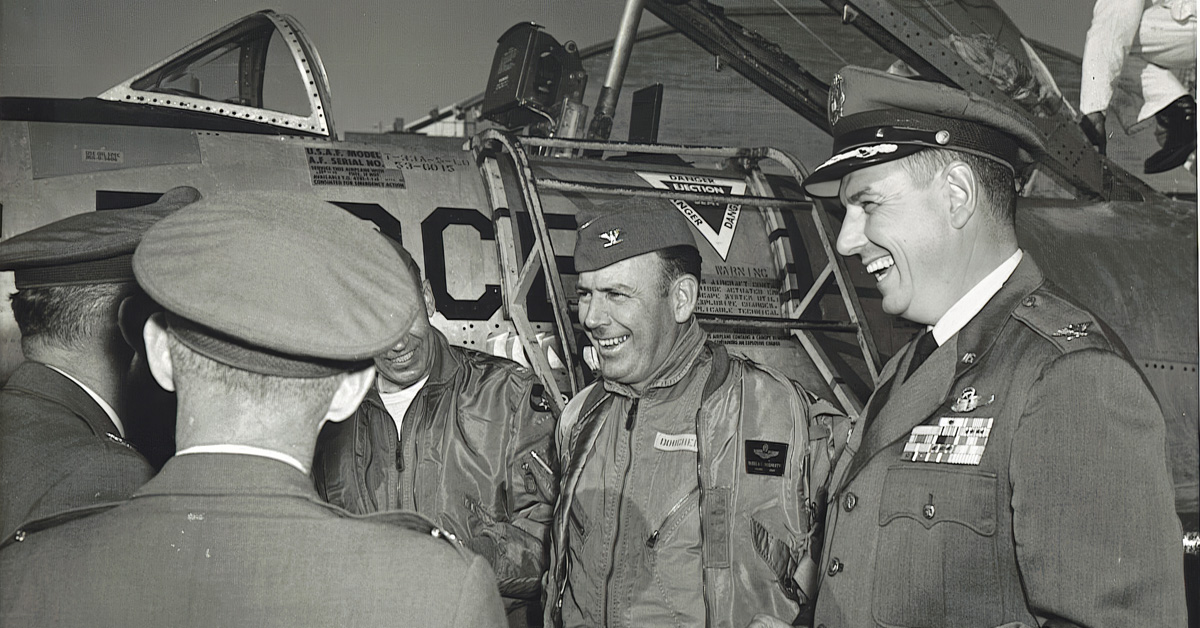
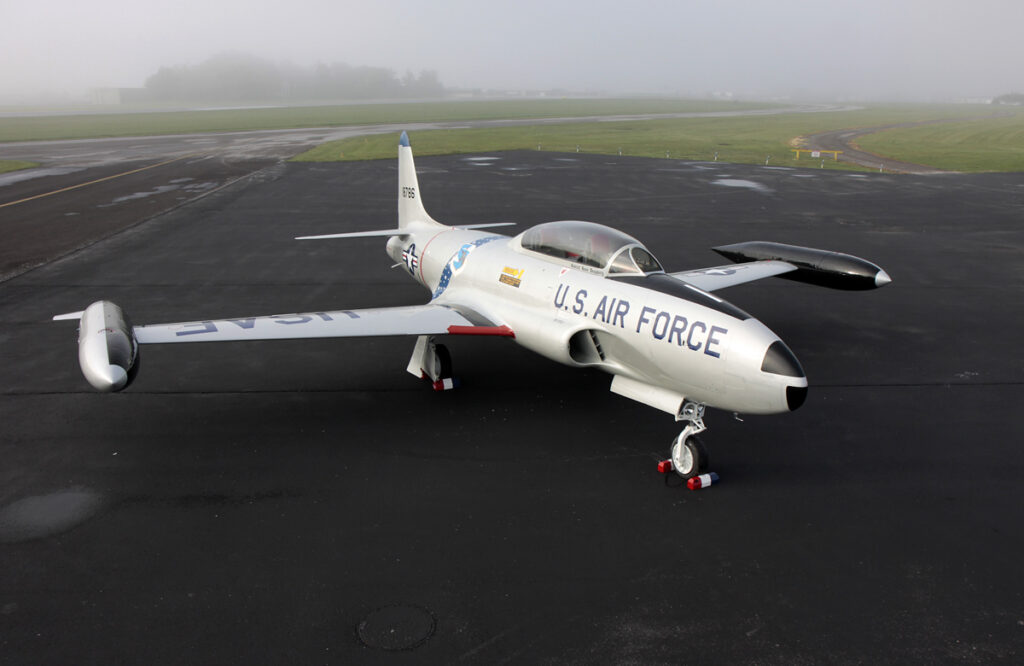
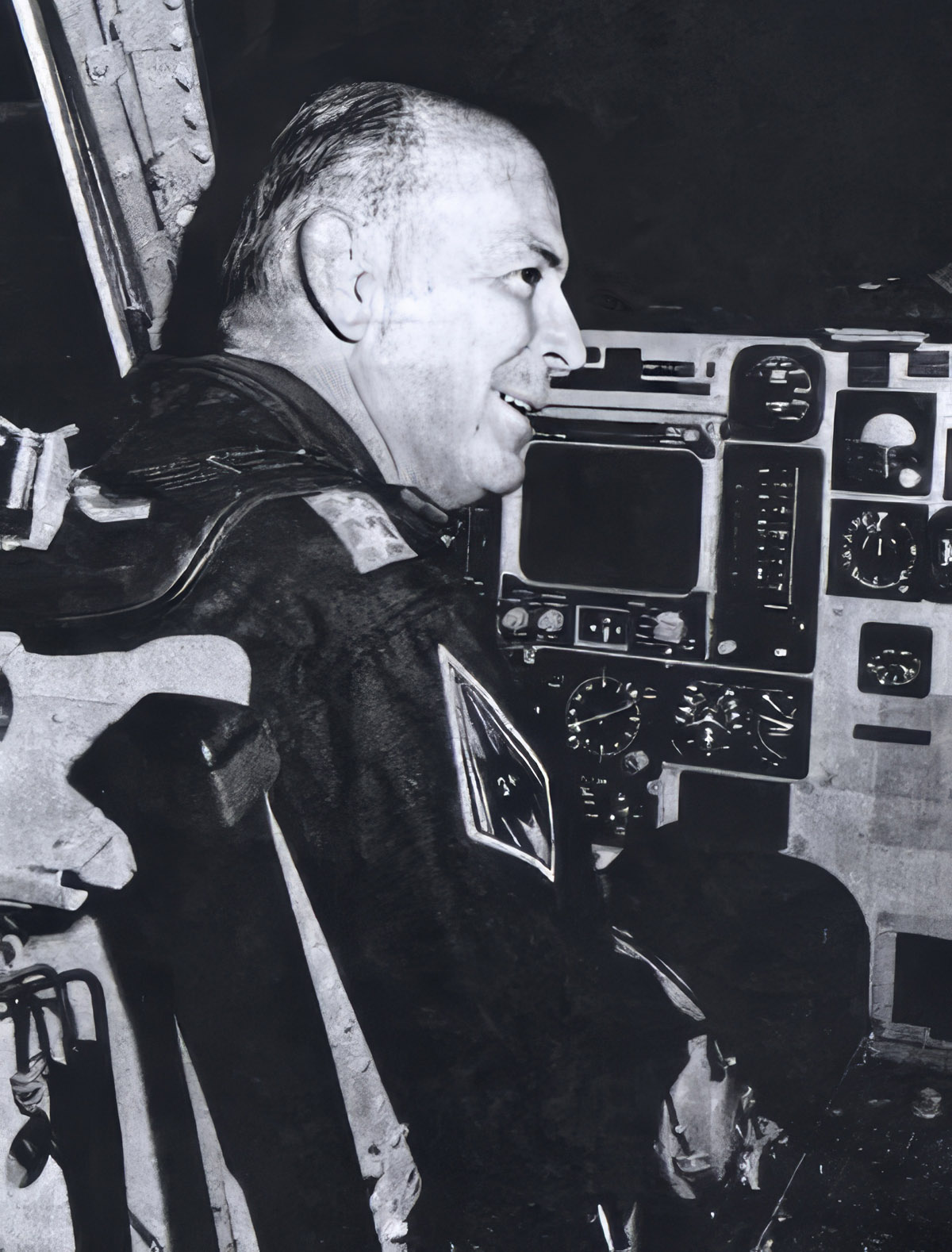
The T-33 Shooting Star at Aviation Heritage Park & Museum honors a man who flew more than 70 different types of aircraft during his remarkable Air Force career. Of all those airplanes, the T-33 was one Gen. Russell E. Dougherty particularly enjoyed flying.
It was also an airplane he would never forget.
In March 1964, Dougherty had recently been promoted to brigadier general and was serving in Washington. Like other staff pilots, he still needed to maintain his flying proficiency, and T-33s at Andrews Air Force Base offered an opportunity to get away from the desk and back into the cockpit.
His son, retired Air Force Col. Mark Dougherty, remembers his father talking about the Saturday “round robin” cross-country flights the pilots made to bases in Ohio, South Carolina or Georgia to stay current. They needed to log the required sorties and flight hours, but there could be practical considerations in choosing a destination. Dougherty remembered particularly good breakfast omelets at Wright-Patterson and excellent lunch possibilities at Shaw and Warner Robins Air Force Bases.
Pilots, as Mark says. What are you going to do with them?

On one of those weekend cross-country flights, Dougherty and Col. Bob Weir took a T-33 from Andrews to Wright-Patterson and then to Warner Robins, Georgia. They had the T-Bird refueled, grabbed a quick lunch and started the final leg home.
At about 30,000 feet, a fire in the aircraft’s plenum chamber began filling the cockpit with smoke.
This was no longer a routine Saturday flight.
The two men knew the aircraft might explode. Dougherty was seated in the rear cockpit, which meant he had to eject first.
The force of the rocket-seat ejection caused both of his arms to strike the canopy rails, breaking them terribly. As he cleared the aircraft, the wind tore away his helmet. His doctors would later tell him he was fortunate his arms had not been severed.
His parachute opened automatically at approximately 14,000 feet.
Badly injured and bleeding, Dougherty still had enough presence of mind, and enough strength in his injured arms, to control the parachute risers attached to the canopy suspension lines. He maneuvered around power lines before safely reaching the ground near the North Carolina-South Carolina border.
Weir came down separately, landing in a tree and suffering a broken back and pelvis.
Help arrived from an unexpected source.
A nearby couple had seen the airmen come down. The woman was a nurse. Seeing the severity of Dougherty’s injuries, she tore strips from her own dress and used them to help stop the bleeding until he could receive medical care.
Dougherty spent about six weeks in the hospital while surgeons reconstructed his elbows and repaired his injuries with skin grafts. Weir’s recovery was even longer.
Sometime afterward, Russell Dougherty did something that tells us a little more about him than surviving the accident does.
He bought his providential on-scene nurse a new dress and mailed it to her.
There were other lessons from the day, some considerably less profound.
An ejection, Dougherty discovered, was an excellent demonstration of why pilots should zip their pockets and fasten their chin straps. As he left the T-33, he watched his helmet, wallet, keys, loose change, checklists and other belongings disappear.
After reaching the ground, he particularly missed his water canteen and the candy bar he had been very much looking forward to eating.
Col. Mark Dougherty, himself a retired Air Force pilot, believes his father's severe arm injuries may have occurred because his elbows were outside the confines of the ejection seat as he squeezed its handles, placing them in the path of the T-33's narrow canopy rails. It cannot be known with certainty, but his explanation comes from a lifetime of experience with military aviation.
The accident did not end Russell Dougherty's flying career.
Nor did it define his Air Force career.
He would go on to wear four stars and ultimately command Strategic Air Command, assuming responsibility for one of the most consequential military commands of the Cold War.
Yet the man who would someday sit at the top of SAC remained, at heart, a pilot who loved flying airplanes.
That is why our beautifully restored silver T-33 at Aviation Heritage Park & Museum is such an appropriate aircraft to bear his name.
It represents more than one frightening flight in 1964, although that flight did leave Dougherty with one distinction that pilots can appreciate: forevermore, his logbook would show more takeoffs than landings.
The T-33 represents another part of General Russell Dougherty, one that coexisted with the lawyer, strategist, commander and four-star general. Flying can be exhilarating and addictive. Just ask any pilot.
Russ Dougherty simply loved to fly.
But long before there were four stars on Russell Dougherty’s shoulders, there was a Kentucky teenager with a bugle, a trumpet and an entirely different plan for his life.
Next in Stories Behind the Aircraft: Part Two – From Bugler to Four Stars: Long before Russell Dougherty commanded Strategic Air Command, he was a Kentucky teenager with a bugle, a young musician with a trumpet, and an aspiring lawyer with an entirely different plan for his life. In Part Two, we follow the unlikely path that took him from the Kentucky National Guard to the cockpit, and ultimately to four stars.
References
Dougherty, Col. Mark, USAF (Ret.). Personal correspondence and family recollections provided to Aviation Heritage Park & Museum, 2026.
Correll, John T. “The Strategic World of Russell E. Dougherty.” Air Force Magazine, February 2005. A biographical profile based extensively on interviews with Gen. Dougherty, family members and colleagues.
Dougherty, Russell E. Oral history interviews and personal recollections cited in biographical and historical research concerning his Air Force career.
“General Russell Elliott Dougherty.” U.S. Air Force official biography. United States Air Force.
Dougherty, Russell E. Oral History Interview, May 24, 2004. General Curtis LeMay Oral History Project, University of North Texas Oral History Program.
Dougherty family collection. Photographs, documents and archival materials provided to Aviation Heritage Park & Museum.