
He Never Came Home
Part One: A Young Man Goes to War
A Parking Space in Washington
In 1939, David Render Berry was visiting Washington, D.C., when a remarkably ordinary event changed the direction of his life.
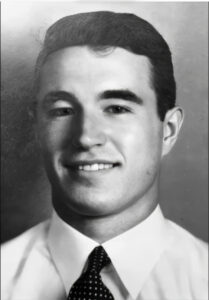
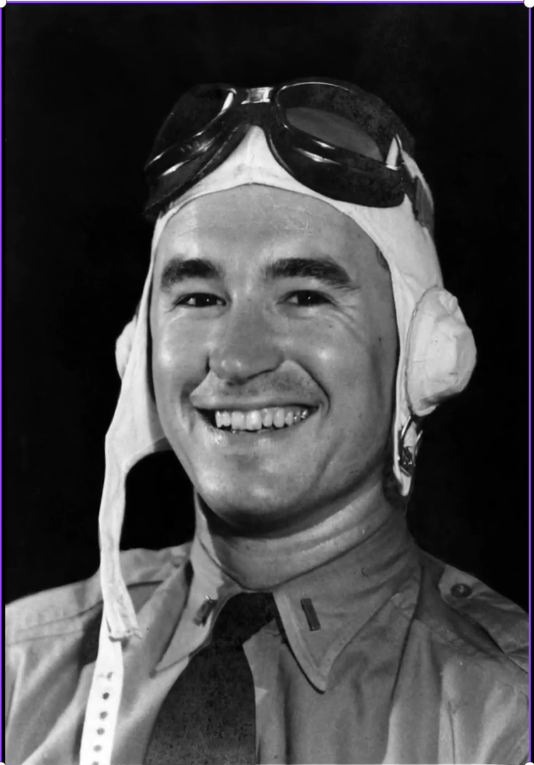
David Render Berry before his wartime Navy service.
Berry was considering military service and, as he later told the story, drove to the War Department intending to investigate the Army. There was nowhere to park. Continuing down the street, he found an open space near the Navy Department instead and went inside to see what the Navy had to offer.
It is the sort of small decision no one would think to remember if everything that followed had been different. Berry learned that the Navy could give him the opportunity to fly. He enlisted, entered flight training and earned his wings as a Naval Aviator in 1940.
Within two years, that young Kentucky pilot would be flying from an aircraft carrier in some of the most important battles of the Pacific war.
Before the War Changed Everything
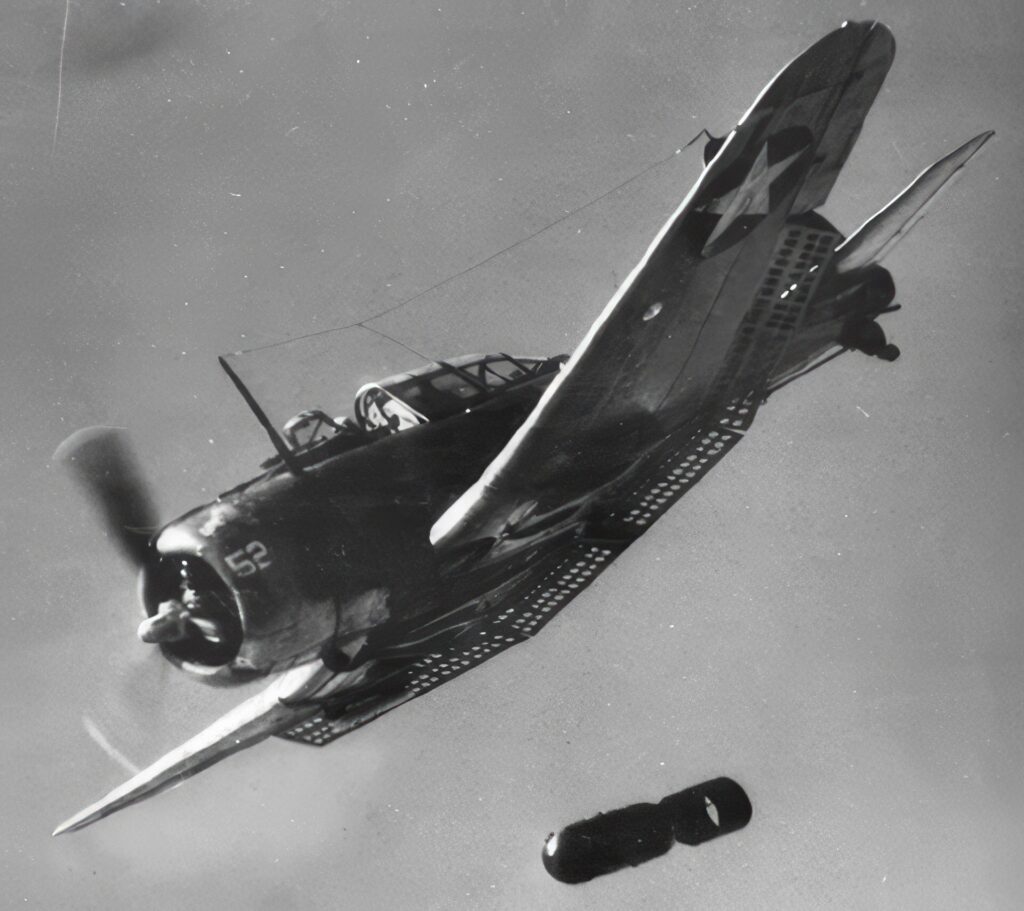
Assigned to Scouting Squadron Five aboard USS Yorktown, Berry flew the Douglas SBD Dauntless, a two-man dive bomber whose method of attack required a pilot to point his aircraft steeply toward an enemy ship, hold the dive as antiaircraft fire rose toward him, release his bomb and pull away.
In 1940, however, Berry was writing his mother from San Diego about considerably more ordinary things. He described watches and inspections, meals and laundry, movies aboard ship and the possibility of getting home for Christmas. He also asked her to send a few necessities, including soap and toothpaste.
Those small details matter because so much of what survives about David Berry concerns the extraordinary things he would soon do. His military records tell us about battles and decorations. His letters remind us that before history made him a hero, he was a son writing home.
Then came Pearl Harbor, and the life David Berry had been living changed almost overnight.
The First Navy Cross
By the spring of 1942, Japan had advanced rapidly across the Pacific, and American forces were fighting to stop an enemy that seemed, for a time, almost unstoppable.
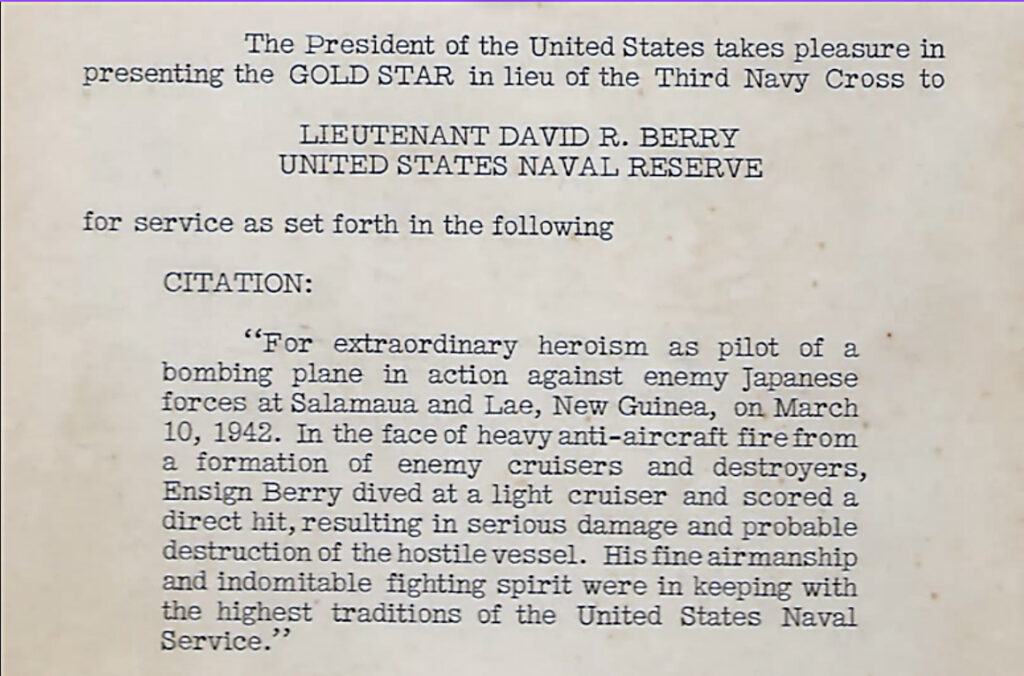
On March 10, Berry flew against Japanese ships at Salamaua and Lae, New Guinea. His official citation describes him pressing a dive-bombing attack through heavy antiaircraft fire against a Japanese light cruiser and scoring a direct hit.
For his actions, Ensign David Render Berry received the Navy Cross, the Navy’s second-highest decoration for valor.
At about the same time, his letters reveal that something else had become very important to him. Her name was Jacqueline.
In a March 1942 letter to his cousin Will, Berry wrote about the war and the frustrations of being far from home. But when he wrote about Jacqueline, what came through was a young man very much in love and thinking about the life he hoped to have with her when the war allowed it.
The war wasn’t going to allow it anytime soon.
Coral Sea and Midway
In May 1942, Yorktown entered the Battle of the Coral Sea, the first naval battle in history in which the opposing fleets fought primarily through aircraft. Berry flew repeated attacks against Japanese forces through heavy antiaircraft fire and enemy fighter opposition. His actions earned him a second Navy Cross represented by a Gold Star.
Less than a month later came Midway.
The Japanese fleet intended to seize the tiny American outpost and draw what remained of the U.S. Pacific Fleet into a decisive battle. Instead, American carrier aircraft dealt Japan a devastating defeat that changed the course of the war.
Berry flew against the Japanese fleet throughout the battle. His citation describes concentrated antiaircraft fire, fierce fighter opposition and repeated attacks against enemy forces. Even after Yorktown, his home at sea, was mortally wounded, Berry and the surviving pilots of his squadron continued flying.
For his actions at Midway, he received his third Navy Cross, represented by a second gold star.
In the space of only a few months, David Berry had earned the Navy Cross three times, making him one of only 12 Naval Aviators of this era to attain this distinction.
It would be easy, looking back, to turn him into the fearless young hero described in wartime newspaper stories. His own words reveal someone more human. When Berry later wrote about combat, he acknowledged fear. He remembered diving toward enemy ships while guns fired at him, seeing his bombs strike and, beneath it all, how badly the men wanted to get home.
His courage wasn’t the absence of fear. He understood what could happen in those airplanes and continued to fly.
Home
David and Jacqueline married in Honolulu on June 20, 1942.
Later, Berry returned to the United States and became a dive-bomber instructor, teaching younger aviators some of what combat had taught him. A contemporary profile suggests that he was a practical teacher. Berry believed young pilots should sometimes be allowed to make mistakes, as long as those mistakes weren’t likely to get them killed. If they discovered for themselves what they had done wrong, he believed they were less likely to do it again.
For a time, David and Jacqueline were able to build something resembling an ordinary married life.
By then, he had already survived the kind of war that could have filled a lifetime. He had fought at Coral Sea and Midway, lost Yorktown and received the Navy Cross three times.
Most importantly, he had come home.
But the war continued, and eventually David Berry chose to return to it.
This time, Jacqueline was expecting their first child.
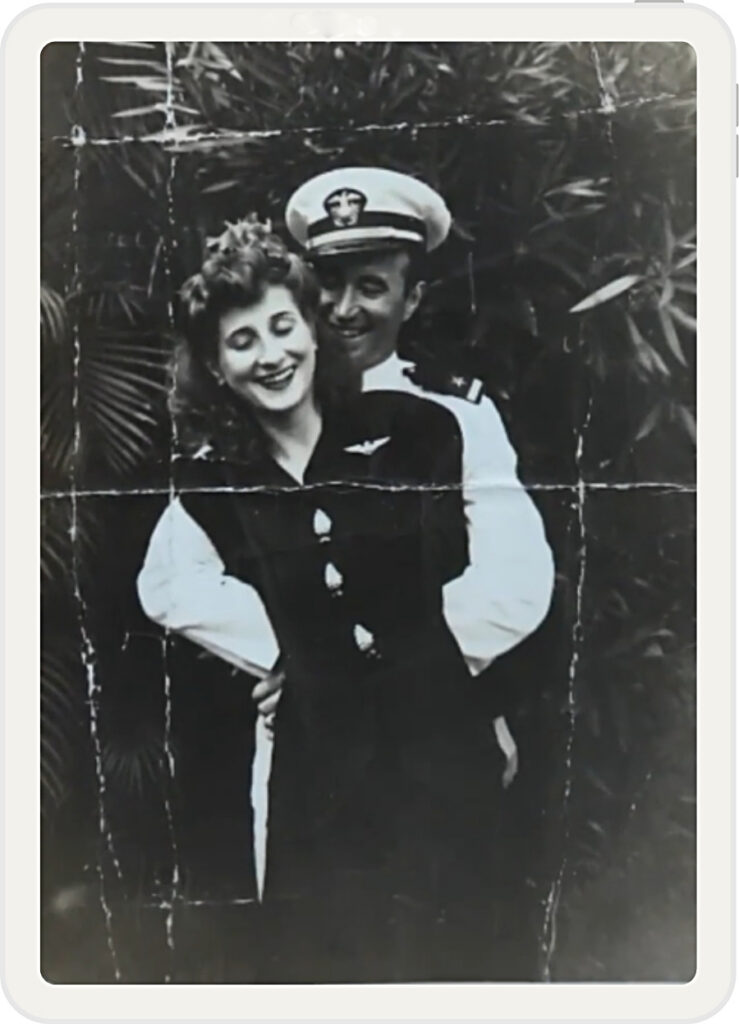
In Part One, a chance parking space in Washington led David Render Berry into the Navy and eventually into the skies over the Pacific. Flying from USS Yorktown, he fought at Coral Sea and Midway and earned the Navy Cross three times before returning home to Jacqueline. But his war was not over. Berry returned to combat, leaving behind a wife who was expecting their first child.
Back to the Pacific
When David Berry returned to the Pacific, he was no longer the young ensign who had first gone into combat in 1942. He was now a lieutenant commander, an experienced combat aviator and the commanding officer of Bombing Squadron 83 aboard USS Essex. Other young men would follow him into the sky and trust his judgment when he led them into combat.
While David returned to war, Jacqueline came to Bowling Green, where she could be close to his family as she prepared for the birth of their baby. His sisters were building lives there, and for Jacqueline, Bowling Green offered something she needed while David was thousands of miles away: people who loved him too.
Letters connected those two worlds, one aboard an aircraft carrier moving ever closer to Japan, the other a family waiting for a baby in Kentucky.
Closer to Japan
By the spring of 1945, Berry was leading his squadron against Japanese ships, airfields and military installations. The fighting was intense, and his men flew repeated missions through heavy antiaircraft fire as American forces closed in on the Japanese home islands.
On April 7, Berry led his squadron into one of the last great naval actions of World War II.
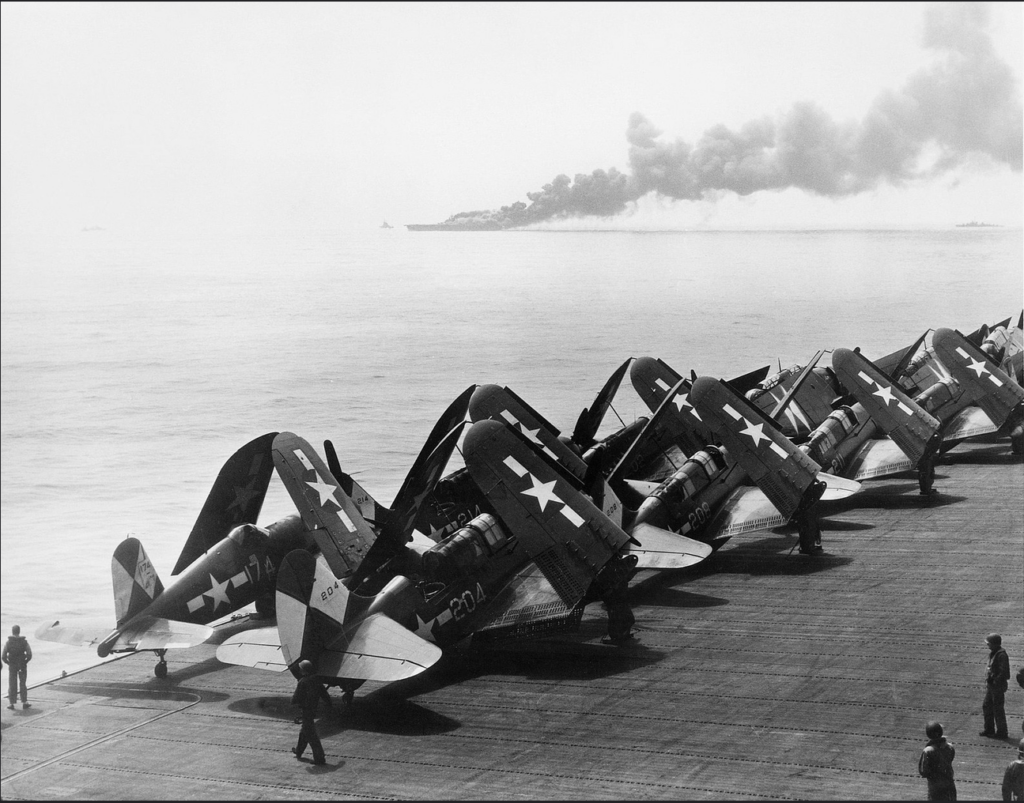
The Japanese battleship Yamato, one of the largest battleships ever built, had sailed toward Okinawa on a mission from which there was little expectation of return. American carrier aircraft found the Japanese force in the East China Sea, and Berry led the Helldivers of Bombing Squadron 83 into the attack. His squadron was credited with eight direct hits against the battleship, helping overwhelm the enormous ship before it sank that afternoon.
It was another extraordinary episode in David Berry’s war. Yet his surviving letters from those weeks show that his thoughts were also thousands of miles away.
He was waiting for news from Bowling Green.
Waiting to Become a Father
On April 18, 1945, Berry wrote home.
Jacqueline had told him that their baby was expected soon, and David realized that by the time his letter arrived, everyone at home might already know something he was still waiting to learn: whether they had a son or a daughter. He wanted them to send the news as soon as possible.
The letter moves between the strange realities of his life. There were long days and difficult flying in the Pacific, but there were also family news, letters from home and thoughts of the baby who would soon make him a father. Most of all, there was his hope that it would not be too long before he could be home with them.
The baby was a girl. Her name was Linda Jo.
By the time David learned that he had a daughter, she was beginning her life in Bowling Green surrounded by people who were waiting with Jacqueline for him to come home.
The Last Mission
On May 13, 1945, Bombing Squadron 83 flew a strike against Saeki Airfield on the Japanese island of Kyushu.
Among the papers preserved by David’s family is the squadron’s action report from that day, allowing us to follow his final flight farther than family memory alone ever could.
Berry led the attack. As he came out of his dive, Japanese antiaircraft fire appeared to concentrate on his aircraft. His recovery was unusually low, and those watching believed his Helldiver was trailing smoke. They saw what appeared to be a parachute emerge from the airplane, but it did not fully deploy. Berry’s aircraft continued on and disappeared from view.
Beyond that, the record cannot tell us what happened. David Berry did not return to Essex, and no trace of him was ever recovered.
Fifteen bombers had gone on the mission.
Fourteen came back.
The Family Remembered
In Bowling Green, Jacqueline had a seven-week-old daughter.
Germany had surrendered only five days before David’s final mission, and the war in the Pacific would end three months later. Jacqueline and the Berry family had every reason to imagine the separation imposed by war would eventually end as so many wartime separations did. The fighting would stop, David would come home, and he would finally meet his daughter.
Instead, Linda Jo would know her father through photographs and letters, through his military record and through the people who had known and loved him.
David’s sisters went on to raise families of their own in Bowling Green. Mary and Jack Donnelly had a large family, while Martha and Charlie Garvin became familiar names to generations of local residents through Beech Bend Park. Their children grew up hearing about David, and the photographs, letters and military records were saved and passed from one generation to the next.
The Navy could record what David Berry had accomplished and the decorations he had earned. His family preserved the man behind them.

The Daughter He Never Met
More than eighty years have passed since David Berry’s final flight. His remains have never been recovered.
Linda Jo was seven weeks old when her father disappeared. She would know him only through the photographs, letters and stories preserved by the family who loved him, growing up with the knowledge that somewhere in the Pacific, in the final months of a terrible war, her father had been trying to come home to her.
Among the papers his family saved is David’s letter from April 18, 1945. Jacqueline was expecting their baby, and he wondered whether, by the time his words reached Kentucky, he would already have a son or a daughter. He asked for the news as soon as possible and wrote of his hope that it wouldn’t be too long before he could be home with them.
Less than a month later, he was gone.
History remembers Lt. Cmdr. David Render Berry for three Navy Crosses, Coral Sea, Midway and a remarkable record of courage in the skies over the Pacific.
But there was one journey he never got to make.
David Berry never came home to meet his little girl.
Sources & Acknowledgments
This story was researched primarily from the David Render Berry family research collection, compiled and preserved over many years by members of the Berry-Donnelly-Garvin family. The collection brings together David Berry’s personal letters and photographs, U.S. Navy service records, award citations and wartime action reports, contemporary newspaper accounts, family records, and other materials documenting his life and military service.
Additional historical and technical information was verified through U.S. Navy and naval aviation historical sources. We also gratefully acknowledge the Aviation Museum of Kentucky for its work in helping share David Berry’s story with a wider audience.
Aviation Heritage Park & Museum extends its special thanks to the Berry-Donnelly-Garvin family for preserving these records, photographs and family memories, and for making them available so that David Render Berry’s story can continue to be told.
Photographs and family documents: Berry-Donnelly-Garvin family collection, except where otherwise noted.