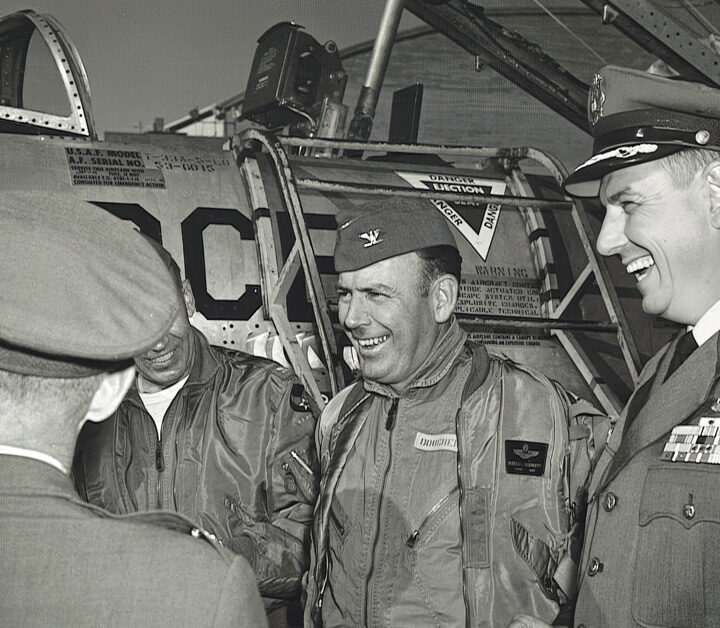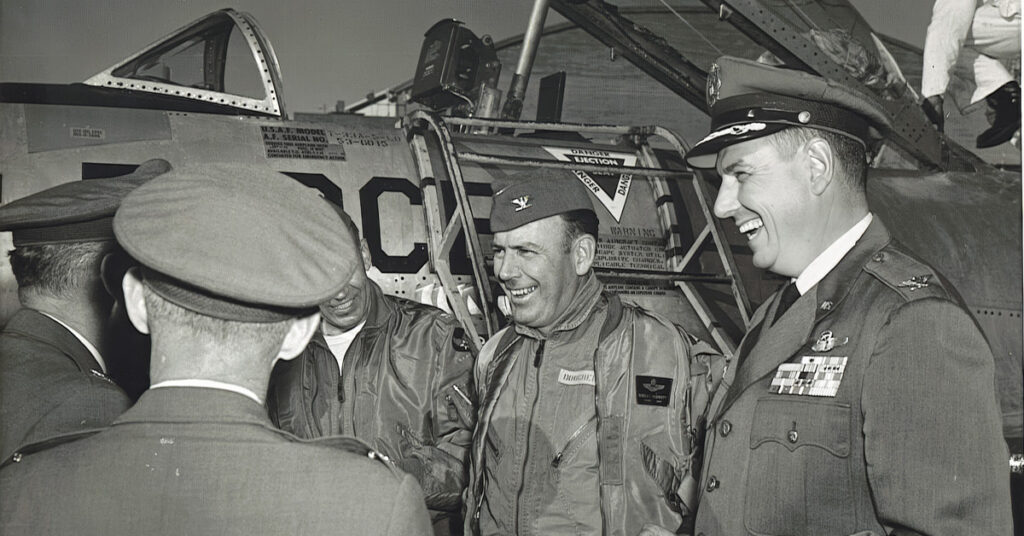
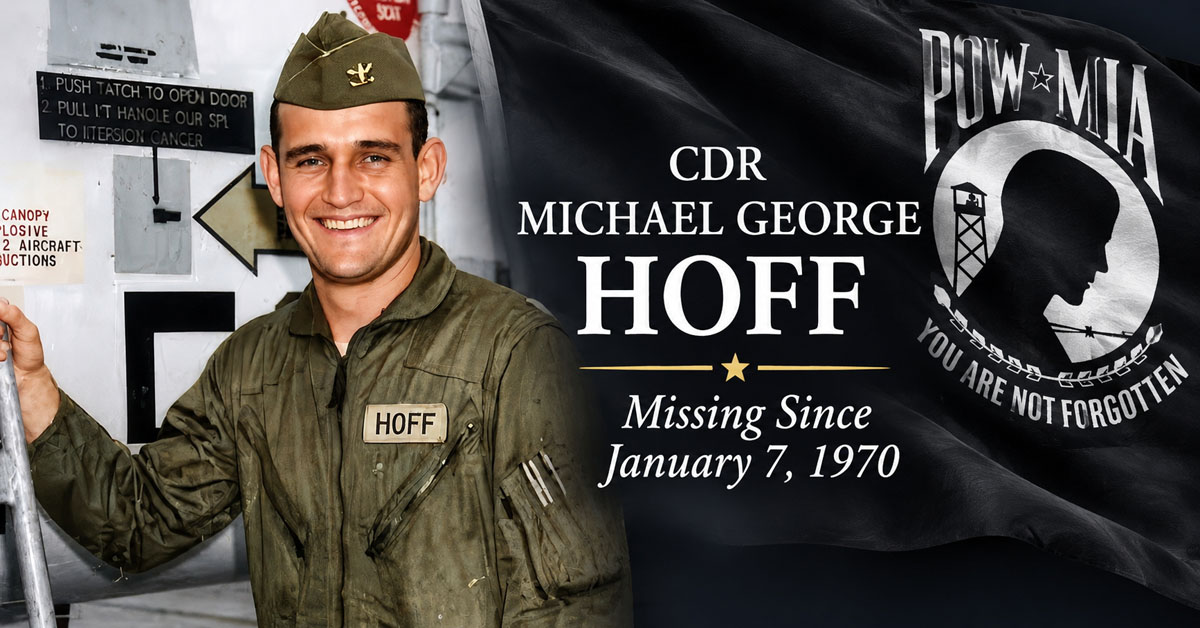
Commander Michael George Hoff, U.S. Navy, missing in action since January 7, 1970. Photo courtesy of the Hoff family.
After Nearly 57 Years, Missing Navy Aviator’s Identification Offers New Hope to Bowling Green Family
The recovery of Commander Michael George Hoff’s military identification marks a significant development in his family’s decades-long search for answers.
BOWLING GREEN, Ky. – For nearly 57 years, Suzanne Hoff Ogawa has lived with unanswered questions about the father she barely knew. Now, the recovery of his military identification among artifacts recently transferred from Vietnam to the United States has brought an unexpected development in her family’s long search for answers.
Her father, U.S. Navy Commander Michael George Hoff, has been missing since January 7, 1970, when his A-7A Corsair II was struck by enemy fire during a combat mission over Laos. On October 29, 2026, Suzanne learned that his military identification was among artifacts associated with 12 missing American servicemen received from the Vietnamese government as part of a humanitarian exchange. The identification is being returned to her, offering a tangible connection to a father whose fate has remained unresolved for more than half a century.
Born September 11, 1936, in Baker, Oregon, Hoff pursued his childhood ambition of becoming a Navy jet pilot. He entered the Naval Aviation Cadet Pre-Flight program in 1957, earned his wings in 1959, and served at naval installations across the country before transitioning to the A-7 Corsair at Naval Air Station Cecil Field in Jacksonville, Florida. By January 1970, he was a lieutenant commander assigned to Attack Squadron 86, the Sidewinders, aboard the aircraft carrier USS Coral Sea.
On January 7, Hoff launched on an armed reconnaissance mission over the Ho Chi Minh Trail in Laos. While attacking enemy ground targets, his aircraft was struck by anti-aircraft fire. He radioed that his plane had been hit and that he would have to eject. Another pilot observed a flash believed to be the ejection seat separating from the aircraft shortly before it crashed and exploded. No parachute was seen, however, and subsequent aerial searches found no trace of Hoff. Enemy activity prevented a ground inspection of the crash site. He was later promoted to commander while listed as missing in action, and the Defense POW/MIA Accounting Agency (DPAA) continues to classify his case as Active Pursuit.
A 1994 Joint Task Force–Full Accounting report documents a 1992 investigation of a suspected crash site in Laos, where a villager provided a damaged flight suit and aircraft wreckage. Investigators found the materials consistent with Navy aviation equipment, while witness accounts suggested the pilot may have ejected while the aircraft was inverted. The site was considered probably associated with Hoff’s disappearance, but the findings did not conclusively establish what happened to him.
When Hoff left for Southeast Asia in September 1969, he left behind his wife, Mary, and five children, ranging in age from newborn to nearly seven. Suzanne was just over two years old and has no personal memories of her father. In a speech recounting her family’s history, she described knowing him through photographs and the recollections of others, who remembered his love of sports and hunting, his enthusiasm for life, and his outgoing personality. “I have no memory of his voice or his laugh,” she said.
The search for answers became a defining part of the family’s life. Mary traveled to Vietnam in the 1970s seeking information about her husband, and Suzanne made her own journey there in 2024. Their efforts reflect the experiences of countless families who have spent decades working with veterans’ organizations and government agencies to account for Americans who never returned from the Vietnam War.
The Hoff family also has a direct connection to one of the nation’s most recognizable symbols of remembrance. Following her husband’s disappearance, Mary Hoff joined other military wives in Jacksonville who were pressing for information about missing servicemen. Seeking a way to raise public awareness, she contacted Annin & Company, a flag manufacturer, and helped initiate the creation of what became the black-and-white POW/MIA flag. Graphic designer and World War II veteran Newt Heisley developed the design in 1971, while Mary requested the black-and-white colors, inspired by photographs of uniforms worn by American prisoners of war. The National League of Families adopted the banner as its symbol in January 1972.
The flag eventually became a national symbol of the commitment to account for missing American service members. Its familiar message, “You Are Not Forgotten,” reflects the cause to which Mary devoted much of her life. Her advocacy also helped establish a Vietnam War memorial at Naval Air Station Cecil Field, dedicated in December 1974. Mary died in November 2015, never receiving the answers she had sought about her husband’s disappearance.
In a recent Veterans Voices television interview at the Vietnam Veterans Memorial replica in Elizabethtown, Kentucky, Suzanne described the complicated emotions surrounding the recovery of her father’s identification. The news brought gratitude that something he had carried would finally be returned, but also frustration that nearly 57 years had passed without an accounting of his fate. She spoke of the difficulty of balancing those feelings and of the mother she wished could have shared this moment.
“My prayer was always while she was alive, that we’d have some information,” Suzanne said, reflecting on her mother’s lifelong search. Although Mary did not live to see this development, Suzanne believes both of her parents would be smiling at the news.
The identification is a significant personal discovery, but important questions remain. The circumstances of its recovery have not been publicly established in the sources reviewed by Aviation Heritage Park & Museum, and the identification alone does not determine whether Hoff successfully ejected or what happened after his aircraft went down. His remains have not been recovered, and his case remains unresolved.
For Suzanne, the discovery also reinforces the importance of remembering those who served and the families who continue to wait. Following her television interview, she expressed particular appreciation for all American veterans, regardless of whether they served in combat, emphasizing that every person who volunteered to serve deserves the nation’s gratitude.
As the nation observes Veterans Day, the story of Commander Michael George Hoff and his family is a reminder that the consequences of war extend far beyond the battlefield. Behind the names engraved on memorials are families who have carried their loved ones’ memories through generations, sometimes without ever knowing what happened in their final moments.
For Suzanne Hoff Ogawa, the recovery of her father’s identification offers something she has waited almost her entire life to receive: a tangible connection to the father she lost as a small child, and perhaps another clue in the continuing search for answers.
Commander Michael George Hoff remains missing. His family continues to wait. And he has never been forgotten.
Sources and Additional Information
- Defense POW/MIA Accounting Agency: Commander Michael George Hoff
- Joint Task Force–Full Accounting: Biographic/Site Report, Case No. 1546, August 9, 1994
- POW Network: Michael George Hoff Biography
- Suzanne Hoff Ogawa’s personal account of her family’s history
- Veterans Voices: Suzanne Hoff Ogawa Television Interview