Stories Behind the Aircraft
Stories Behind the Aircraft is a continuing series from Aviation Heritage Park and Museum exploring the people, missions, and moments behind the aircraft that tell their stories.
The Sound of Help Coming
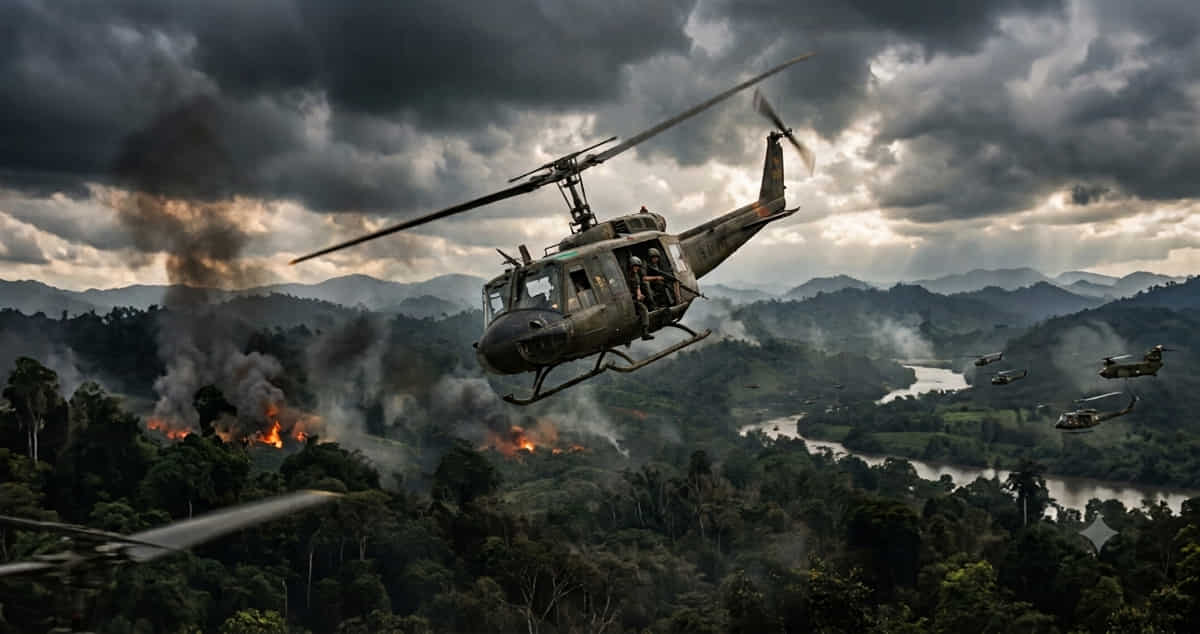
Every week, Vietnam veterans visit Aviation Heritage Park and Museum.
Many of them walk directly to one aircraft.
The Huey.
Some place a hand on its weathered skin. Others stand quietly for several minutes, remembering. More than a few wipe away tears.
Ask them why, and you’ll hear nearly the same answer every time.
“The Huey meant help was coming.”
For the soldiers fighting on the ground in Vietnam, that unmistakable sound overhead meant hope. It meant ammunition. Reinforcements. Medical evacuation. Sometimes, it simply meant another chance to live.
For the young men who flew those helicopters, it meant something else.
It meant flying toward the danger everyone else was trying to escape.
One of those pilots was Major Ray Nutter.
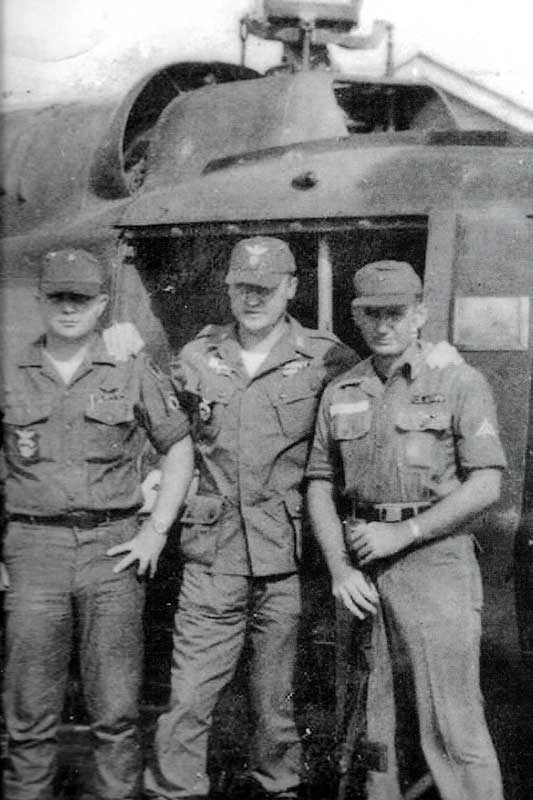
Major Ray Nutter (center) with members of his Huey crew following the October 18, 1966 mission.
On October 18, 1966, Nutter was leading an armed helicopter platoon supporting combat operations near Vi Thanh in South Vietnam. A small friendly force had become trapped under overwhelming enemy fire. Helicopter gunships fought desperately to protect evacuation helicopters attempting to rescue the isolated soldiers, but the enemy’s fire was so intense that the rescue aircraft were forced to turn back.
Leaving those men behind wasn’t an option.
Major Nutter volunteered to make the rescue himself.
As his Huey descended into the landing zone, enemy fire tore through the helicopter. Bullets riddled the cabin. The controls were shot away. His fellow pilot was killed instantly.
The crippled aircraft crashed into a flooded mangrove swamp deep inside enemy-controlled territory.
Nutter survived with a severe wound to his leg.
The real test was only beginning.
With Viet Cong soldiers already closing in on the wreckage, Nutter gathered his two surviving crewmen and led them away from the helicopter and deeper into the swamp. The three wounded Americans began an exhausting journey through waist-deep water, tangled mangroves, and enemy territory.
The official Distinguished Service Cross citation tells the story in the understated language typical of military records. It notes that Major Nutter led his crew through the swamp despite his wounds, enduring cold, mosquitoes, leeches, exhaustion, and constant danger. Twice, when enemy soldiers discovered their position, he defended his crew with only a knife. Throughout the night they remained hidden while artillery shells fell nearby, waiting for daylight and the chance to reach friendly forces.
Years later, the adventure magazine Saga devoted a feature article to the ordeal, dramatically titled 18 Hours to Freedom. Like many magazines of its era, it told the story with vivid language and cinematic detail, describing the shattered helicopter, the flooded mangrove swamp, and the desperate struggle to survive. While its style reflected the sensational adventure writing popular in the 1960s, the courage at the heart of the story was very real.
By the following morning, after nearly eighteen hours behind enemy lines, Major Nutter and his two crewmen finally made contact with friendly forces.
For his extraordinary heroism that day, Ray Nutter received the Distinguished Service Cross, the nation’s second-highest award for valor. Many who have studied the mission have long believed his actions deserved even higher recognition.
Today, the Huey displayed at Aviation Heritage Park and Museum honors Colonel Ray Nutter and every Army aviator who answered impossible calls for help. It stands as a tribute not only to one extraordinary pilot, but to every crew that flew toward danger when others needed them most.
To many visitors, it’s an impressive helicopter.
To those who served in Vietnam, it is something far more personal.
It is the sound they prayed to hear.
The sound of help coming.
Continue Exploring
- Colonel Ray Nutter Biography
- UH-1 Huey at Aviation Heritage Park and Museum
- Read the original Saga magazine article, 18 Hours to Freedom