
Photo credit: Library Special Collections, WKU
Brigadier General Victor Herbert Strahm (1897-1957) was a distinguished American military aviator, serving with valor in both World War I and World War II. A pivotal figure in early U.S. air power, Strahm was a WWI flying ace, a WWII commander, and an aviation pioneer with connections to figures like Eddie Rickenbacker and Charles Lindbergh.
Born in 1897 to German immigrant and musician Franz Strahm in Nashville, Tennessee, his family later moved to Bowling Green, Kentucky, in 1910, where his father headed the music department at Western Kentucky State Normal School (now Western Kentucky University – WKU). Much of what is known about Strahm’s early life and service comes from letters and memorabilia donated to the Kentucky Library at WKU.
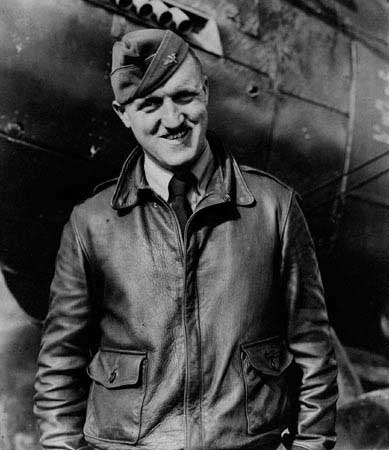
World War I Flying Ace In 1917, as an engineering student at the University of Kentucky, Victor Strahm enlisted in the U.S. Army. He quickly joined the nascent Army Air Service (later the U.S. Army Air Forces), drawn by an advertisement for college students with electrical engineering backgrounds. After receiving flight training in the U.S. and France, he was assigned to the 91st Aero Squadron. Strahm conducted vital aerial photographic reconnaissance missions, often engaging in intense dogfights with German aircraft. During his WWI service, he shot down a total of five German airplanes, earning him the designation of a flying ace. He was awarded the Distinguished Service Cross for his extraordinary heroism. Photos from this period show him alongside notable figures like Prince Edward of Great Britain and General Billy Mitchell. Strahm maintained his involvement in aviation between the wars, with other photos depicting him with famous aviators such as Eddie Rickenbacker and Charles Lindbergh.
World War II Commander & “Over the Hump” Missions General Strahm continued his heroic service in World War II. He joined the Tenth Air Force in India, where he flew critical “Over the Hump” missions from Calcutta over the Himalayas. These dangerous flights supplied nationalist Chinese forces in China, demonstrating his commitment to the war effort in challenging environments.
Later in WWII, then Brigadier General Strahm served as Chief of Staff to General Lewis Brereton, playing a crucial role in the Desert Campaign. His Ninth Air Force was instrumental in bombing campaigns in Italy and Romania before relocating to England in preparation for the retaking of France. Strahm’s personal diaries from 1944 offer unique insights into the intensity of the air war, including his observation of delivering “500 tons in 30 hours” of bombs.
Retirement and Legacy Victor Strahm’s distinguished military career was cut short due to health reasons; he suffered a heart attack in 1953, which led to his grounding and subsequent retirement. Brigadier General Victor Herbert Strahm passed away in 1957, leaving behind a legacy as a trailblazing aviator who served his country with exceptional bravery and leadership across two World Wars.
Strahm was inducted into the Aviation Museum of Kentucky in 2019. The Kentucky Library at Western Kentucky University has a collection of Brigadier General Strahm’s artifacts. Strahm is honored at Aviation Heritage Park as a distinguished Kentucky aviator.
Book review used for this biography was written by Dr. Richard Weigel, History Department WKU.


