More Takeoffs Than Landings
Part One: The T-33
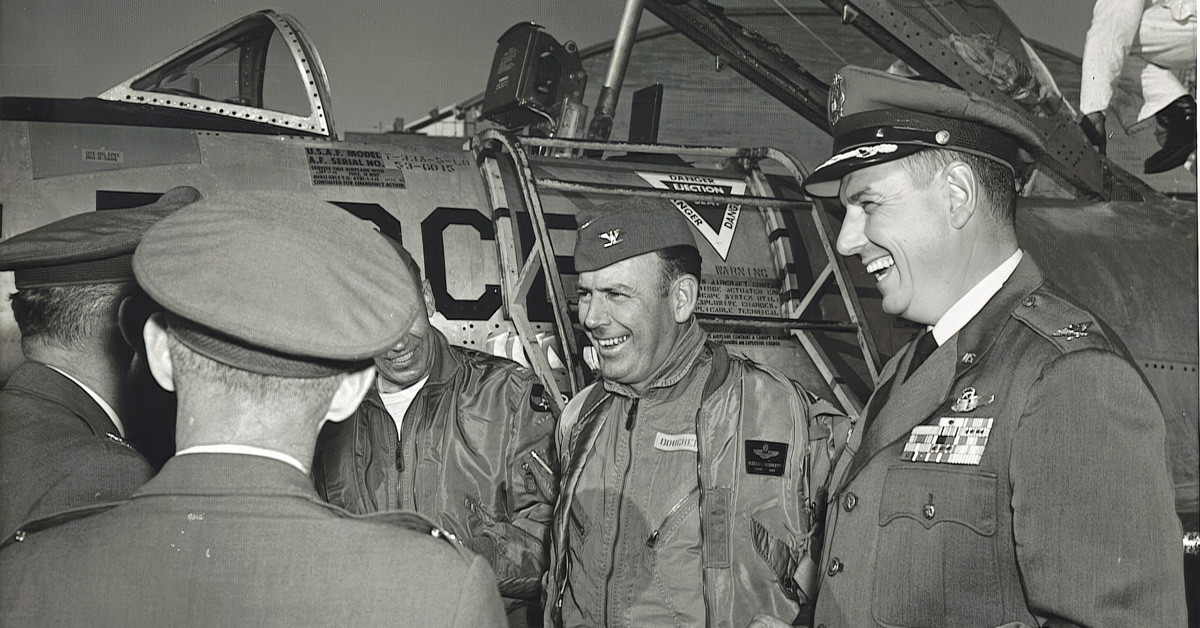
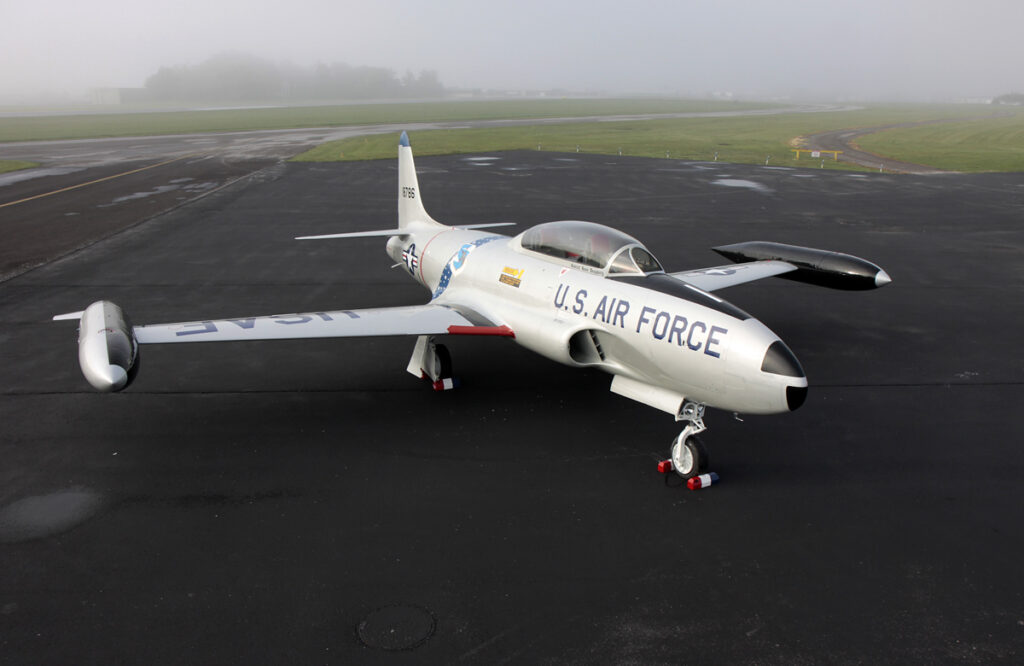
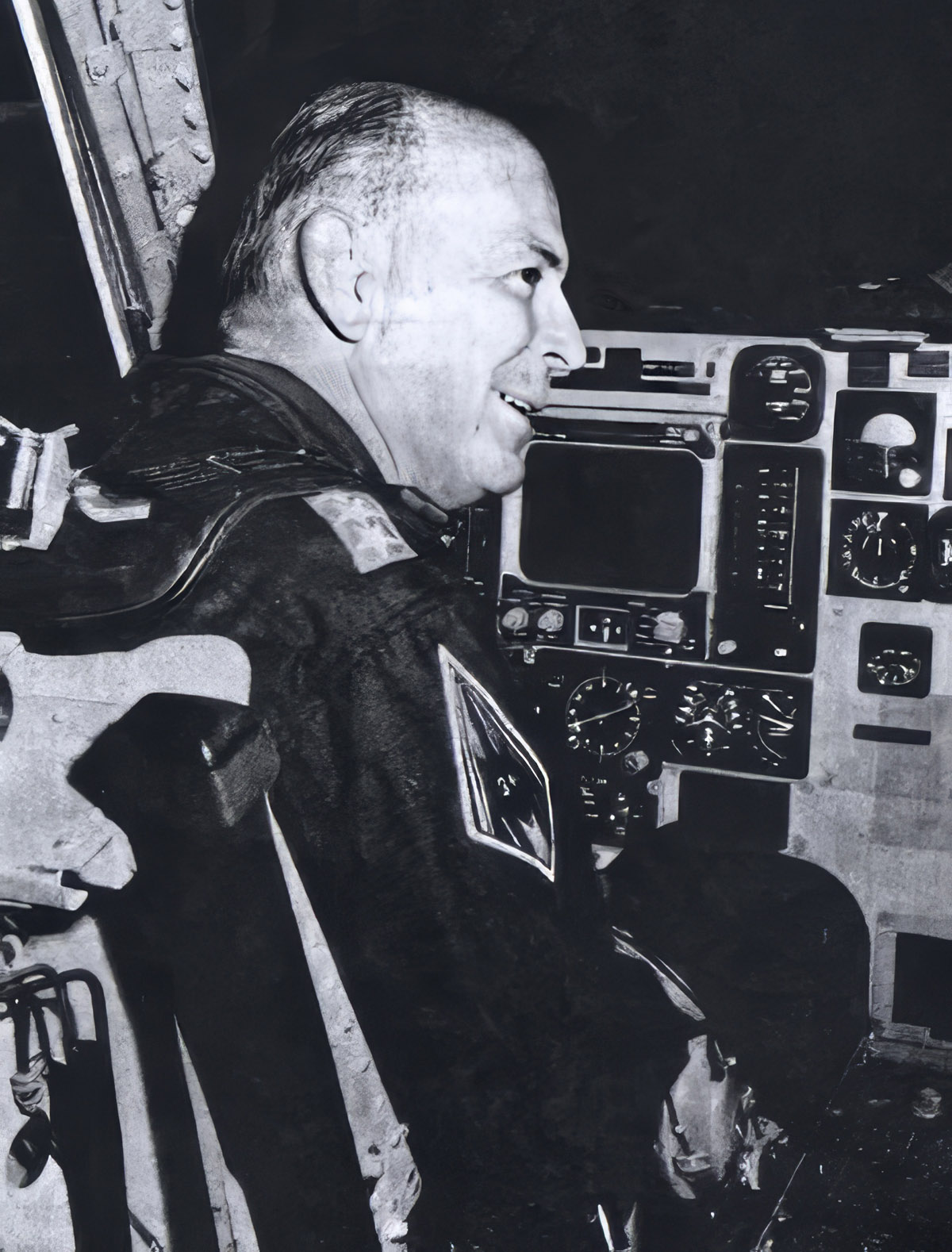
The T-33 Shooting Star at Aviation Heritage Park & Museum honors a man who flew more than 70 different types of aircraft during his remarkable Air Force career. Of all those airplanes, the T-33 was one Gen. Russell E. Dougherty particularly enjoyed flying.
It was also an airplane he would never forget.
In March 1964, Dougherty had recently been promoted to brigadier general and was serving in Washington. Like other staff pilots, he still needed to maintain his flying proficiency, and T-33s at Andrews Air Force Base offered an opportunity to get away from the desk and back into the cockpit.
His son, retired Air Force Col. Mark Dougherty, remembers his father talking about the Saturday “round robin” cross-country flights the pilots made to bases in Ohio, South Carolina or Georgia to stay current. They needed to log the required sorties and flight hours, but there could be practical considerations in choosing a destination. Dougherty remembered particularly good breakfast omelets at Wright-Patterson and excellent lunch possibilities at Shaw and Warner Robins Air Force Bases.
Pilots, as Mark says. What are you going to do with them?

On one of those weekend cross-country flights, Dougherty and Col. Bob Weir took a T-33 from Andrews to Wright-Patterson and then to Warner Robins, Georgia. They had the T-Bird refueled, grabbed a quick lunch and started the final leg home.
At about 30,000 feet, a fire in the aircraft’s plenum chamber began filling the cockpit with smoke.
This was no longer a routine Saturday flight.
The two men knew the aircraft might explode. Dougherty was seated in the rear cockpit, which meant he had to eject first.
The force of the rocket-seat ejection caused both of his arms to strike the canopy rails, breaking them terribly. As he cleared the aircraft, the wind tore away his helmet. His doctors would later tell him he was fortunate his arms had not been severed.
His parachute opened automatically at approximately 14,000 feet.
Badly injured and bleeding, Dougherty still had enough presence of mind, and enough strength in his injured arms, to control the parachute risers attached to the canopy suspension lines. He maneuvered around power lines before safely reaching the ground near the North Carolina-South Carolina border.
Weir came down separately, landing in a tree and suffering a broken back and pelvis.
Help arrived from an unexpected source.
A nearby couple had seen the airmen come down. The woman was a nurse. Seeing the severity of Dougherty’s injuries, she tore strips from her own dress and used them to help stop the bleeding until he could receive medical care.
Dougherty spent about six weeks in the hospital while surgeons reconstructed his elbows and repaired his injuries with skin grafts. Weir’s recovery was even longer.
Sometime afterward, Russell Dougherty did something that tells us a little more about him than surviving the accident does.
He bought his providential on-scene nurse a new dress and mailed it to her.
There were other lessons from the day, some considerably less profound.
An ejection, Dougherty discovered, was an excellent demonstration of why pilots should zip their pockets and fasten their chin straps. As he left the T-33, he watched his helmet, wallet, keys, loose change, checklists and other belongings disappear.
After reaching the ground, he particularly missed his water canteen and the candy bar he had been very much looking forward to eating.
Col. Mark Dougherty, himself a retired Air Force pilot, believes his father's severe arm injuries may have occurred because his elbows were outside the confines of the ejection seat as he squeezed its handles, placing them in the path of the T-33's narrow canopy rails. It cannot be known with certainty, but his explanation comes from a lifetime of experience with military aviation.
The accident did not end Russell Dougherty's flying career.
Nor did it define his Air Force career.
He would go on to wear four stars and ultimately command Strategic Air Command, assuming responsibility for one of the most consequential military commands of the Cold War.
Yet the man who would someday sit at the top of SAC remained, at heart, a pilot who loved flying airplanes.
That is why our beautifully restored silver T-33 at Aviation Heritage Park & Museum is such an appropriate aircraft to bear his name.
It represents more than one frightening flight in 1964, although that flight did leave Dougherty with one distinction that pilots can appreciate: forevermore, his logbook would show more takeoffs than landings.
The T-33 represents another part of General Russell Dougherty, one that coexisted with the lawyer, strategist, commander and four-star general. Flying can be exhilarating and addictive. Just ask any pilot.
Russ Dougherty simply loved to fly.
But long before there were four stars on Russell Dougherty’s shoulders, there was a Kentucky teenager with a bugle, a trumpet and an entirely different plan for his life.
Next in Stories Behind the Aircraft: Part Two – From Bugler to Four Stars: Long before Russell Dougherty commanded Strategic Air Command, he was a Kentucky teenager with a bugle, a young musician with a trumpet, and an aspiring lawyer with an entirely different plan for his life. In Part Two, we follow the unlikely path that took him from the Kentucky National Guard to the cockpit, and ultimately to four stars.
STORIES BEHIND THE AIRCRAFT
Gen. Russell E. Dougherty
Part Two: From Bugler to Four Stars
Long before Russell E. Dougherty commanded Strategic Air Command, he had another military job.
He played the bugle.
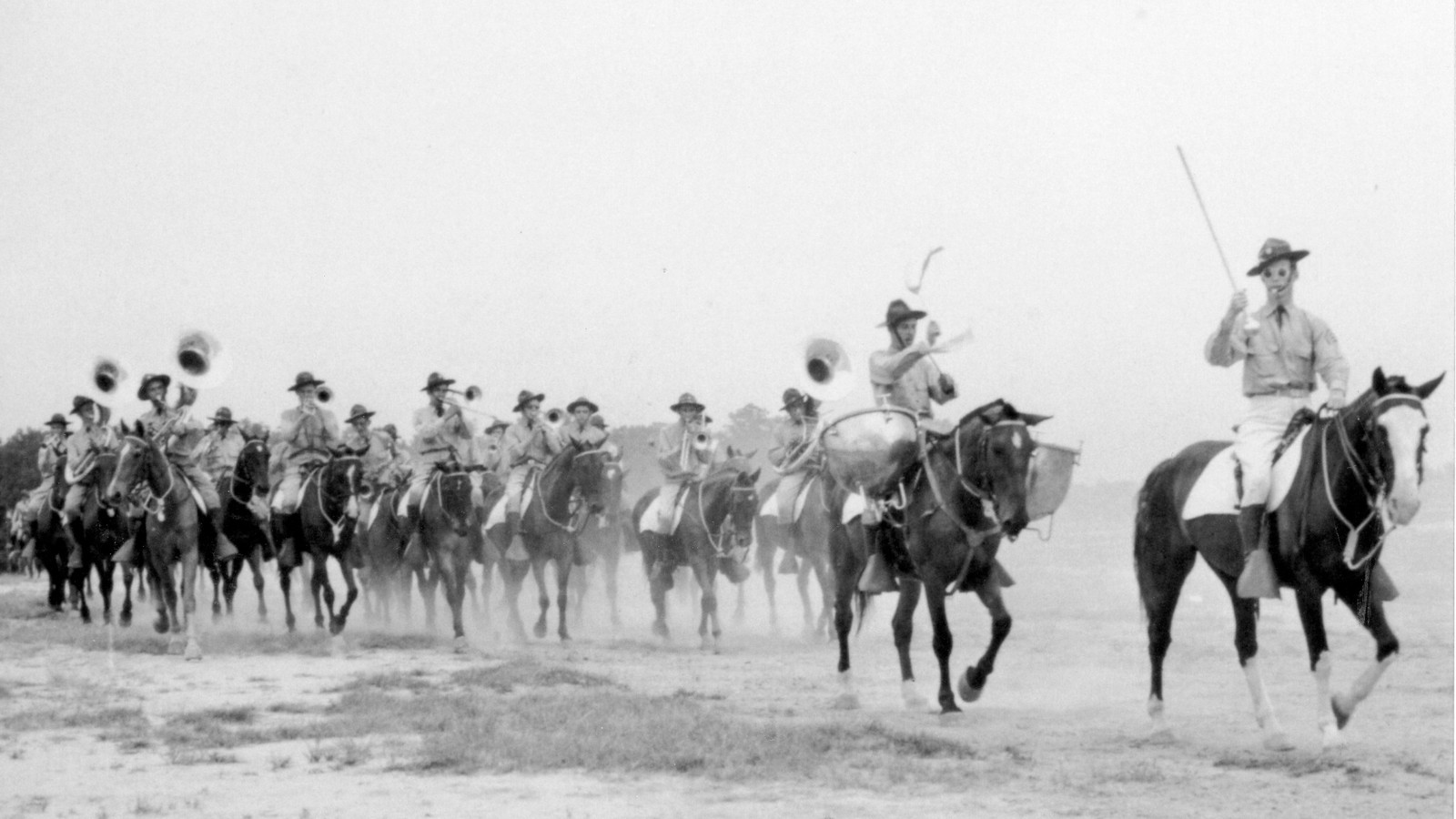
Dougherty was just 15 years old in 1935 when he joined the Kentucky National Guard’s 123rd Cavalry. The headquarters troop needed a bugler, and its commander knew the teenager from Glasgow already played trumpet in his high school band and around town. That summer at Fort Knox, the young guardsman sounded the bugle and helped care for the captain’s horse. He remained with the cavalry through high school and college.
At the time, Dougherty wasn’t dreaming of becoming a general. He had already decided what he wanted to be. Growing up near the Barren County courthouse, he sometimes watched trials and had been influenced by a judge who lived next door. By about age 12, his mind was made up: Russell Dougherty was going to be a lawyer.
Music helped him get there.
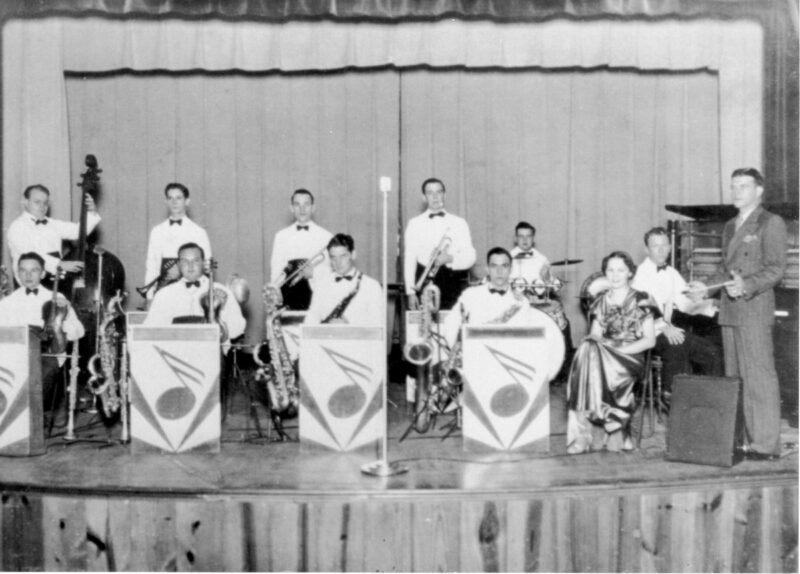
At Western Kentucky, Dougherty played trumpet and managed a dance band to help pay his way through college. One of the band’s other musicians was fellow Glasgow native Billy Vaughn, who would become one of America’s best-known bandleaders of the 1950s. On occasion, a young singer from Nashville named Dinah Shore sang with them.
But another singer would matter considerably more to Russ Dougherty.
Geralee “Gerry” Shaaber of Louisville appeared with the band one night at a fraternity dance. She was engaged to someone else at the time, an obstacle the young trumpet player apparently did not regard as insurmountable. Dougherty later recalled that he “managed to disengage her.” Russ and Gerry eventually married while he was a lieutenant in the Army Air Corps.
The dance band did more than introduce Dougherty to his future wife. It helped pay for his education. Years later, he said one of the greatest satisfactions of his life was knowing that he had put himself through four years of college and three years of law school without costing his parents a penny.
He graduated from Western Kentucky University in 1941 and headed to Washington to study law while working for the FBI. The plan seemed to be proceeding nicely.
Then came World War II.
Dougherty entered the aviation cadet program, earning his pilot wings and commission in the Army Air Corps in 1943. He initially served as an instructor pilot and later flew B-17s before qualifying in the B-29 Superfortress, then the most advanced bomber of the war.
Somewhere along the way, the future lawyer encountered a problem.
He fell in love with airplanes.
“While I was in law school, I recognized that I had fallen in love with flying big airplanes,” Dougherty later recalled. Flying, he admitted, had begun to hold more appeal than the law.
There was also another future celebrity aboard one of those big airplanes. Dougherty’s B-29 bombardier was 1st Lt. Ernest Jennings Ford of Tennessee. The world would later know him as Tennessee Ernie Ford, and the two men remained friends. Decades later, when Dougherty organized an Air Force Association Gathering of Eagles in 1986, Ford was there to help lead the singing of the Air Force song.
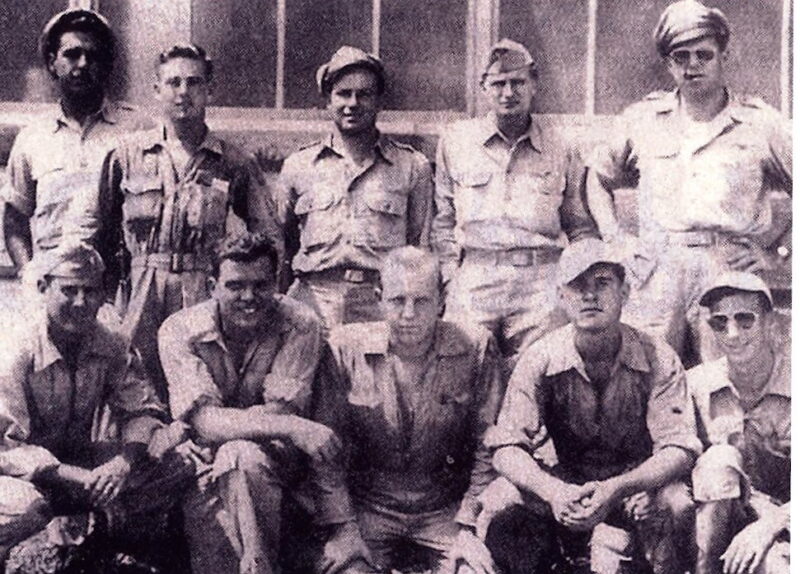
When World War II ended, however, Dougherty did not immediately abandon the future he had planned since childhood. He entered the University of Louisville School of Law, graduated in 1948 and passed the Kentucky bar. Even then, the two paths refused to separate neatly. Dougherty served as a judge advocate while continuing to fly, including an assignment on Guam where he flew with the 19th Bombardment Wing while also practicing military law.
For several years, he managed to keep one foot in each world. The law had been his ambition since boyhood. Flying had become his passion.
In 1952, the airplanes won.
Dougherty left the legal specialty, completed aircrew refresher training and returned to flying operations. He would spend much of the next several years in Strategic Air Command as it grew into the powerful force at the center of America’s Cold War nuclear deterrent.
His career increasingly combined skills that once might have seemed unrelated. The pilot understood aircraft and operations. The lawyer understood the importance of precise language and careful reasoning. The musician who had spent his college nights leading a dance band knew something about communicating with an audience. All of those abilities would serve an officer moving steadily into larger commands and increasingly complex planning responsibilities.
The years that followed took Dougherty through operational commands, Strategic Air Command, the Pentagon and NATO. He served in Washington during the Cuban Missile Crisis and later became the Air Force deputy chief of staff for plans and operations. In 1971, he took command of 2nd Air Force, which included most of SAC’s B-52 bombers and KC-135 tankers.
Then, in 1972, Russell E. Dougherty received his fourth star.
Two years later, he became commander in chief of Strategic Air Command, assuming responsibility for the bombers, tankers and intercontinental ballistic missiles at the heart of America’s strategic deterrent.
It was a remarkable destination for a journey that had begun nearly four decades earlier with a 15-year-old boy, a bugle and a horse at Fort Knox.
But perhaps the most interesting thing about Russell Dougherty’s rise was that he never entirely left those earlier versions of himself behind. The lawyer remained attentive to words and ideas. The pilot never lost his love of airplanes. The musician remained a communicator. And somewhere inside the four-star general was still the Kentucky boy who had discovered very early that he could work hard enough to make his own way.
Rank tells us how far Russell Dougherty rose.
It doesn’t entirely tell us what kind of man arrived there.
For that, we have to look behind the four stars.
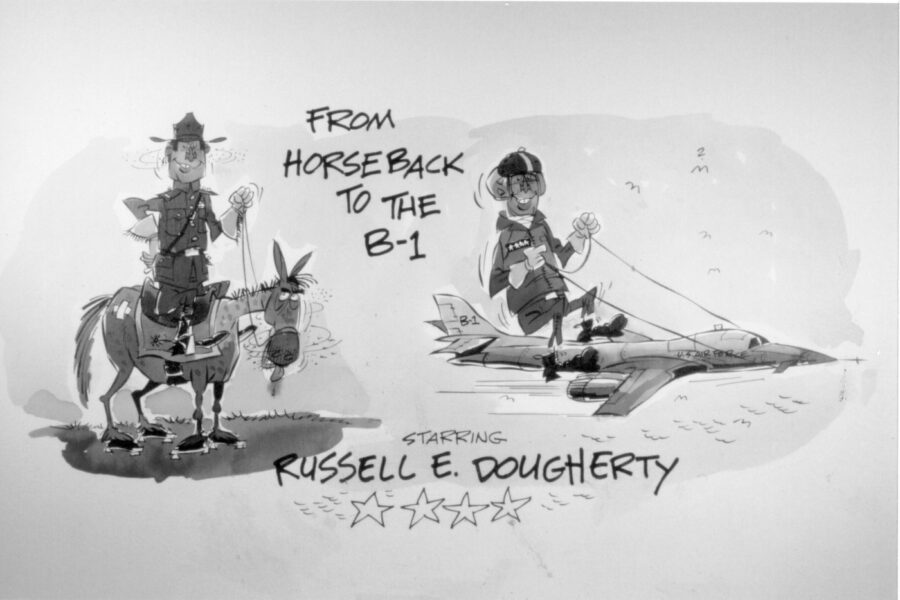
Next: Part Three — The Man Behind the Four Stars
Four stars can tell you how far a man rose. They don’t tell you what he was like when the office door was open, when he stopped to talk with the night shift at 2 a.m., or when he went home to the family that had followed him through a lifetime of moves.
In the final part of our series, we’ll step away from the résumé and meet Russ Dougherty: husband, father, friend and commander. Through the memories of the people who knew him best, we’ll discover the man behind the four stars.
References
Dougherty, Col. Mark, USAF (Ret.). Personal correspondence and family recollections provided to Aviation Heritage Park & Museum, 2026.
Correll, John T. “The Strategic World of Russell E. Dougherty.” Air Force Magazine, February 2005. A biographical profile based extensively on interviews with Gen. Dougherty, family members and colleagues.
Dougherty, Russell E. Oral history interviews and personal recollections cited in biographical and historical research concerning his Air Force career.
“General Russell Elliott Dougherty.” U.S. Air Force official biography. United States Air Force.
Dougherty, Russell E. Oral History Interview, May 24, 2004. General Curtis LeMay Oral History Project, University of North Texas Oral History Program.
Dougherty family collection. Photographs, documents and archival materials provided to Aviation Heritage Park & Museum.
Swiech, Robert G. Retrenchment: General Russell E. Dougherty and the Strategic Air Command During the Age of Détente. Thesis, School of Advanced Air and Space Studies, Air University, Maxwell Air Force Base, Alabama, June 2014.
“World War II Scrapbook.” Air Force Magazine, September 1995, p. 52. Photograph and identification of Lt. Russell E. Dougherty and his B-29 crew at MacDill AFB, Florida, in early 1945, including bombardier Tennessee Ernie Ford.
I am text block. Click edit button to change this text. Lorem ipsum dolor sit amet, consectetur adipiscing elit. Ut elit tellus, luctus nec ullamcorper mattis, pulvinar dapibus leo.